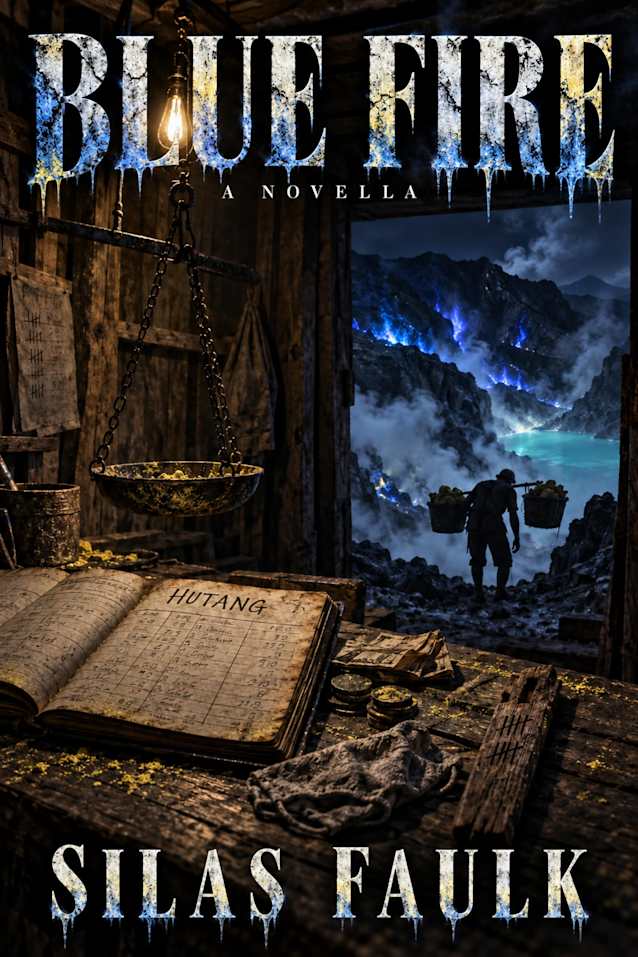
Blue Fire
About
“The first living man I ever fed to the lake was still screaming when I carried him down.”
So begins the confession of Slamet Darsawening — a name that means safe, given by a father who died coughing sulfur, spoken over a son the mountain would claim anyway.
In the Tirtawangi highlands of eastern Java, the volcano called the Rahang — the Jaw — burns blue in the dark. Inside its crater, debt-bonded men carry ninety-kilo loads of raw sulfur up the inner wall on wooden yokes, two trips a night, while an acid lake the color of turquoise glass steams below them. The lake dissolves rope. It dissolves boots. It dissolves teeth, bone, and names.
Which is why the powerful men of the valley pay the foreman so well. Because the Rahang is not only a mine.
It is a disposal service.
Slamet came to the mountain at twenty to carry his father’s debt. He learned the yoke, the scale that always lies, the ledger that only grows. Then he learned the other work — the night work — the men brought up the mountain who never came down, and the price of watching, and the steeper price of helping. Now, at the end of his life, he is writing it all down: every load, every body, every silence he purchased with his own survival. His wife. His brother. The teacher who taught him letters, and what those letters cost. He is not asking for forgiveness. He is asking you to climb down into the crater with him and see what the blue fire showed him — about debt, about power, and about how an ordinary man becomes the rope in another man’s hands.
BLUE FIRE is extreme horror in the literary tradition — a testimonial nightmare in the vein of Tender Is the Flesh, written as one man’s unflinching account of an atrocity machine built from poverty and gravity. There are no monsters on the Rahang. There is only the lake, the ledger, and the men who feed them both.
Around Slamet, the mountain assembles its cast: Sasi, the wife he married with sulfur money and lies; Maruta, the younger brother he swore would never climb; Karsan, the foreman whose ledger is the only scripture the crater honors; old Pak Marno, who has survived forty years by knowing exactly which questions kill; and the tourists at the rim, who pay to photograph the famous blue flames at night and never once look down at the men burning beneath them. Above, the fire is beautiful. Below, it is a wage.
Faulk builds his horror the way the mountain builds silicosis — load by load, night by night, until the reader realizes the trap closed chapters ago. The gore, when it comes, is anatomical and unblinking: the acid work of the lake, the iron bar and its craft, the slow drowning that ends every carrier who isn’t ended faster. But the deeper terror is economic. Every atrocity in this book is somebody’s job.
One mountain. One ledger. One account of where the weight goes.
Some debts are paid in sulfur. The rest are paid in men.
Reader advisory: This novella contains graphic body horror, torture, captivity, coercive control, dismemberment, and suicide. Intended for adult readers. Not for the faint of heart — and not, in the end, forgettable.
From Silas Faulk, author of GROSS NEGLECT and THE SETTLING.